Divestment

It’s been an age since I last updated this blog. The changing nature of my work and the increased opportunities for adventures with my family have taken the time I used to spend on writing articles and posts. With our kids heading off to college in the Fall, I would like to return to communicating more if only because writing for a public audience has a tendency to improve your own thinking and also others have sometimes found what I write to be of use.

One big investment I’ve been making over the past weeks is starting to make significant shifts in where I spend my time and money online towards emerging technologies like Substack and Bluesky and away from Amazon, Meta, and Musk-owned brands in particular. I’m taking a pragmatic approach, keeping those products that are hard to do without for now but existing those that are secondary to my day to day life. For example I cancelled Instagram and Threads, but am keeping Facebook for now but choosing not to log in and deleting the apps and notifications from my phone.

We’re also looking at making changes in where we shop, where we get medical care, etc. This is not just responding to the poor behavior of the people who run these properties, but also to the decline in quality of experience that monetization efforts have driven. In particular, while I have some concerns about Google as an enterprise, the SEO and placed ads in Google results swamp most useful content, making the internet like a highway covered in billboards through which you can no longer enjoy the landscape. I’ve been trying Duck Duck Go as my primary search engine and finding that it’s good enough for my purposes, does not have the same SEO-heavy biases, and that I don’t really miss Google much anymore.

I’ll be writing more about how to diversify your online footprint and what some good alternatives are in the coming weeks. In the meantime, I’m sending my best wishes to everyone who is being negatively impacted by the current social and political changes.
MyIBD and Personalized Learning highlighted by Harvard Business Review

Heather Kaplan of the Cincinnati Children’s Hospital, with a little help from the rest of us, published a highlight of the state of our work on the Personalized Learning System via HBS’s online blog.  The article emphasizes the patient-physician collaboration model we’ve been working on and that I teased at MedicineX last week.

http://blogs.hbr.org/2013/10/a-personalized-learning-system-for-improving-patient-physician-collaboration/

What can a concerned citizen do in the face of injustice?

The juxtaposition of verdicts in the Zimmerman and Alexander cases, and the unapologetic, non-reflective response of most of our political leadership leaves me wondering what I, as a concerned citizen I can do in the face of a pervasive national moral cowardice. As a citizen of a republic, I could choose to move to Florida or Mississippi and cast my vote against the representatives of injustice, misogyny, ignorance and racism who seem to frequent the media. But would that really have an impact proportionate to the personal sacrifice involved? Unlikely.

Continue reading “What can a concerned citizen do in the face of injustice?”

Advanced inspector middleware for Clojure nREPL

Last night I promoted a new nREPL middleware project, ‘nrepl-inspect’, derived from the javert library.

nrepl-inspector on GitHub

This repository contains:

  • an Emacs client file that extends nrepl.el, and
  • a rich generic middleware inspector that runs under nREPL.

Key features include:

  • ‘C-c C-i’ inspects the var at point, or any value returned by eval of an arbitrary expression in the current buffer’s active namespace,
  • a simple model for recursing into sub-objects based on a value index map maintained in the middleware during serialization of the value, and
  • a rendering method extensible for custom types.

My goal is to be able to stack navigate a Datomic database given an Entity, the example in the repository should support that with just a little more work.

Please note, while I use this in my day to day development, but it’s not yet well packaged and has been minimally tested.  It currently does not truncate maps or sequences, so please don’t inspect ‘(repeat 1)’!

Gmail Messages Skip the Inbox

Four days ago I stopped getting mail from my academic mail account on my iPhone and Mac Mail. I was in a bit of a crunch so didn’t really pay attention since I still got some mail on my business and non-profit accounts in a unified Inbox.  Imagine my surprise Monday when I realized I hadn’t received new and important e-mail since Thursday!

Apparently Gmail engineers fixed some bugs in the last month or two and when those changes propogated to my account, it changed the behavior of certain filters that were not, er, perfectly well defined.  If you had filter (such as before:2011/01/01) to cause all messages before a certain date to skip the Inbox (which is useful when migrating from old accounts), then this may have happened to you.  The Gmail Inbox feeds through Imap to the iPhone and Mac Mail clients, so they would no longer see new mail.  The mail is still there, just under “All Mail” instead.  Fix the filters, and life goes back to normal.

Debut of the Higgs

The Higgs Boson has finally made an appearance on stage at the LHC (large hadron collider)! Looks like the fireworks are in Europe this 4th of July.  The last element of the standard model has been empirically confirmed leaving us with 12 constituent particles, 4 forces, and the Higgs boson for mass (not shown) to predict most of what we see in the observable universe.

Back in 1995 I had the good fortune to be sitting in the class of astrophysicist Alan Guth (http://en.wikipedia.org/wiki/Alan_Guth), co-inventor of Inflationary model of the Big Bang which explained the uniformity of the cosmic background radiation discovered by physicists Penzias (now at NEA!) and Wilson.   Continue reading “Debut of the Higgs”

On the Road Again

After a summer travel hiatus to work on research projects, I’m back on the road again this week.

Today, I’m chairing a break-out panel at Mayo Transform 2011 to talk about the power and opportunities in sharing health data across organizational and discipline boundaries.  Tomorrow I’m participating in a break-out discussion featuring Hugh Dubberly on self-tracking and visualization, also at Transform.  Check out the alternative announcmeent on the fantastic new Lybba.org website and blog.

On Thursday I’m participating on a panel about Innovation Scaning sponsored by the Office of the National Coordinator for Health Information Technology and the Health 2.0 team in DC.  

It feels great to exchange ideas in real-time with my collaborators the larger health innovation community again.  As always, Transform is off to a great start!

OS X Lion?

Mac OS X updates often contain controversial features that lead people to wonder whether they should upgrade.  My short answer is there is no need to rush into Lion.  The only feature that I think is a real step forward is the new facilities for search in Mac Mail and increased support for cool gestures.  Even if those sound appealing, wait a couple of incremental releases for some of the various quirks to subside and more apps to integrate with the Lion look and feel changes.

  • Gestures.  Very nice, smooth, worthwhile.
  • Content scrolling.  Annoying, go to the Properties and disable for normal up/down two-finger scrolling
  • Look and Feel. Animations make the system feel slower.  Generally feels a little awkward to me.  I suspect you’ll be able to turn off animation in a future release.
  • Mission Control.  Expose + Spaces might have been harder for basic users, but mission control is a step backward for power users.  If you use those features heavily, you may want to hold off for awhile.  I’m disappointed by Mission control on multiple monitors.  It’s also feels slower than the old Spaces + Expose.  May be due to the animation issues.
  • New Mail widescreen layout and search functionality.  Search is great.  Almost worth the upgrade by itself.  New layout is nice when on small screens.
  • Safari 5 + Lion.  Faster!  Zippier!  Could just be the new js and rendering suppport, but feels good.  Sometimes the sandboxed renderer eats up CPU cycles and memory and there is no way to tell what tab is responsible.  Just force kill the Safari content process.
  • Fullscreen apps.  Meh.  Ok for mobile use and interacts cleanly with Mission Control.
  • Rosetta (Power PC binary support) is deprecated.  Beware of older programs; some programs may still be using Rosetta under the hood and negatively surprise you.

That’s it.  Of the hundreds of features they tout, those are the only ones that really pop out for me.  Generally the overall feel of the system remains inferior after several weeks of use.  

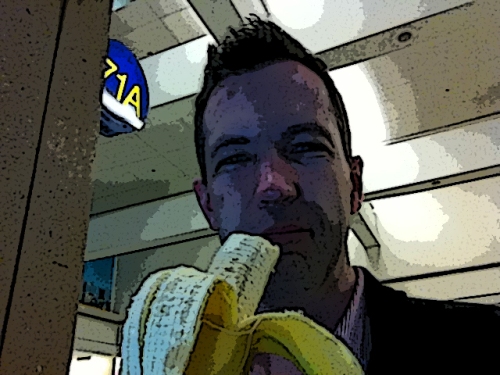
    Holy Radioactive Bananas!

    I was reminded today by my social media brethren (thanks Jesse) that bananas are radioactive. They contain roughly 450mg of potassium and the isotope K-40 has a natural abundance of 0.01% which translates to 0.01 millrems per day. The radiation is split between 80% beta decay, 10% electron capture and 10% gamma rays.

    Perhaps this explains my wife’s strong aversion to bananas? Continue reading “Holy Radioactive Bananas!”

    The Collaborative Chronic Care Network (C3N)

    I just returned from spending a day with the team working on the Collaborative Chronic Care Network (C3N) who are part of the amazing ImproveCareNow (ICN) network of clinics as well as some very creative visionaries building the Anderson Center of the Cincinnati Children’s hospital. 

    ICN/C3N is focused on helping the families of children with Crohn’s disease or other IBS/IBD diseases like Ulcerative Colitis.  In recent years the team has focused on improving care delivery by showing how a network of centers can systematically improve care delivery by being disciplined in measuring and sharing outcome data.  They actively seek to translate learnings from over and under performing centers or sub-populations to change care delivery across the network and effect a shift in the mean outcome curve for chronic disease.

    More to the point, they are actually implementing the data collection, cross-institutional transparency and systems processes we all talk about. Continue reading “The Collaborative Chronic Care Network (C3N)”